Short answer
Birch plywood from Vietnam comes in three honest constructions: birch face and back over a plantation hardwood core, birch face over a combi core with birch cross-bands, and full birch multiply built from imported birch veneer. Only the third is comparable to Baltic birch, and it costs accordingly because the veneer is imported. Face grades run D/E, C/D and D+/D for furniture work. Panel sizes are 1220×2440 mm and 1250×2500 mm, thickness 3–25 mm, with MR, WBP, E1 or E0 glue depending on the destination market. Ask any supplier which of the three they are quoting before you compare prices — most price differences you see are construction differences, not margin.
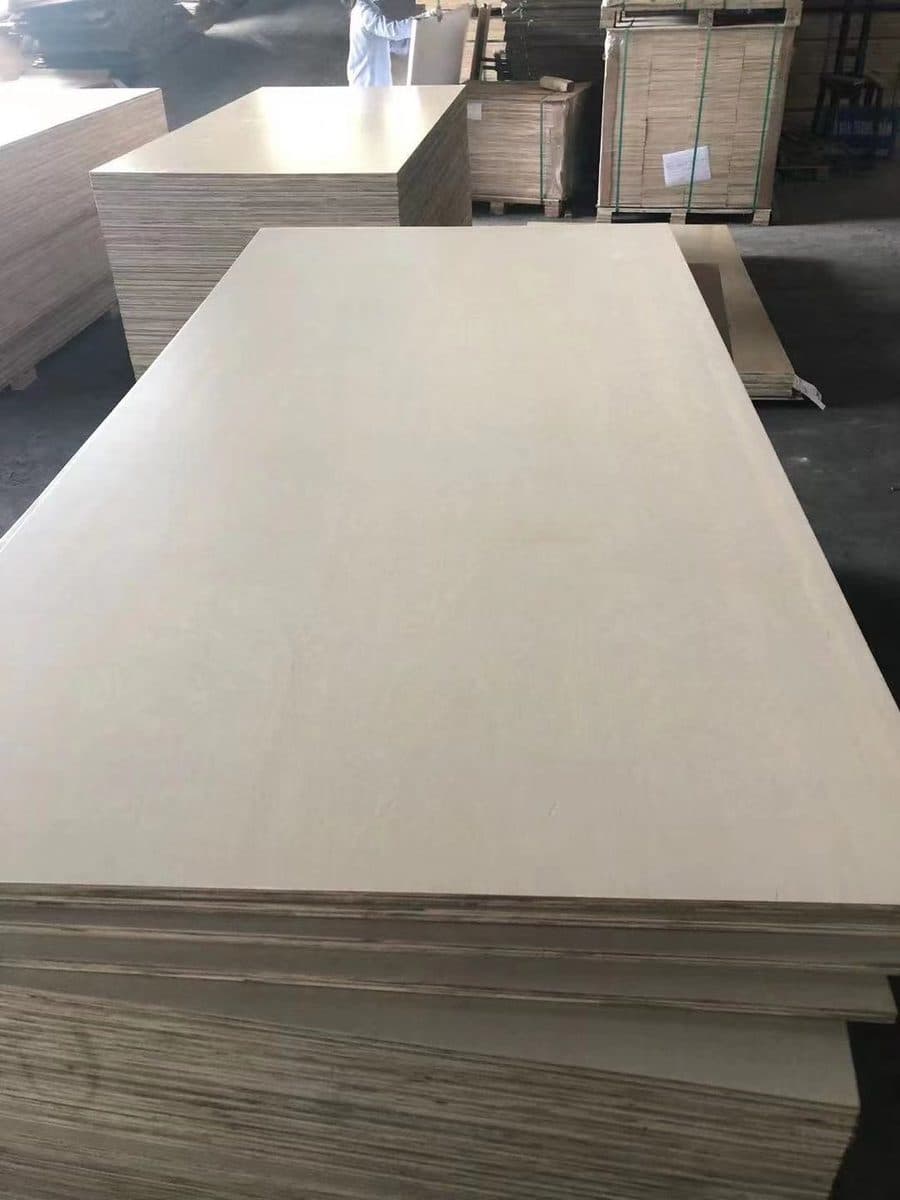
Is Vietnamese birch plywood the same as Baltic birch?
No, and any supplier who says it is has told you something you can check. Baltic birch is full birch multiply — every ply is birch, cut from cold-climate logs grown in Finland, Latvia, Estonia and formerly Russia. That density and that void-free core are the reason cabinet makers pay for it. Vietnam has no birch forest. Every gram of birch in a Vietnamese panel is imported veneer or imported lumber.
What Vietnam does have is a mature veneering and pressing industry, plantation acacia and eucalyptus cores with predictable density, and — since 2023 — a supply chain that is legally clean in a way Russian birch no longer is. For a buyer whose real problem is a sanctioned or undocumented origin, that combination is worth more than matching Baltic birch ply-for-ply.
What do the grades D/E, C/D and D+/D mean?
The two letters describe face and back separately — face first. In the birch grading convention used across Asia, B is a clean face with matched colour, C allows sound knots and small repairs, D allows open defects and patches, and E is the utility back where appearance does not matter. So C/D means a presentable face over a rough back, and D/E is a working panel that will be painted, laminated or hidden.
Grade letters are not an international standard the way NHLA lumber grades are — two mills can call the same panel C/D and D+/D. This is why we send physical face samples before a first order and why you should insist on them. A photo of a panel proves nothing about the patch count per square metre.
- D/E — painted, laminated or structural-hidden work; highest patch tolerance
- C/D — visible face for cabinet interiors, drawer sides, shop fittings
- D+/D — a working compromise where both sides are semi-visible
- Face thickness 0.3–0.6 mm rotary birch veneer; ask which, it changes sanding tolerance
Which core should I specify?
Plantation hardwood core — acacia or eucalyptus — is the default and the reason Vietnamese birch-faced panels are competitive. Density lands around 620–680 kg/m³, screw holding is good, and the raw material is traceable to plantation plots, which matters for EUDR. Its weakness is edge appearance: cut it and you see a core that does not look like birch.
Combi core puts birch cross-bands directly under the face, which cleans up the visible edge and stiffens the panel, at roughly a 12–18% price step. Full birch multiply gives the exposed-edge look designers want but the veneer is imported, so the price sits close to European product and the lead time follows veneer availability. Specify by what the panel has to do, not by what it is called.
What glue and emission class do I need for my market?
For the United States the binding requirement is TSCA Title VI, which mirrors CARB Phase 2 — panels must be certified by an EPA-recognised third-party certifier and carry the certifier and mill identification. Our partner mill holds CARB/EPA 21023 through ICTT Corporation (TPC-43), covering HWPW-VC hardwood plywood 2–21 mm, 3–13 plies, valid to 25 May 2027.
For the EU, formaldehyde sits under E1 as a market expectation and CE marking under EN 13986 as the legal route for construction use. Our chamber test result on the film-faced line is 0.05 mg/m³ against an E1 limit of 0.124 mg/m³ (SGS VNHL2606013466HG, 16 June 2026). For furniture panels specify E0 if your customer's own specification calls for it — it is a real production change, not a label.
How do I stop a birch quote from being compared unfairly?
Write the specification yourself and send the same sheet to every mill. Six lines are enough: panel size, thickness, construction (face-only / combi / full birch), face and back grade, glue and emission class, and the destination market. Without those six lines you are comparing a D/E acacia-core panel against a C/D combi panel and concluding that one supplier is expensive.
Then ask for the same three documents from each: the FSC Chain-of-Custody certificate with its licence code, the emission certificate covering the exact thickness range, and a past shipment document pack. A mill that can produce all three in a day has a system. A mill that takes a week is assembling one for you.
Questions buyers ask about this
What HS code does birch plywood ship under?+
Plywood with at least one outer ply of birch falls under HS 4412.33 in most tariff schedules, with national subdivisions splitting panels that have a birch outer ply from those that do not — the EU uses 4412.33.10 for birch-faced. Birch sawn lumber is 4407.96 and birch logs are 4403.96. Your customs broker makes the final classification for your shipment.
Can you supply full birch multiply, all plies birch?+
Yes, from imported birch veneer, and we will tell you the veneer origin before you order. Be aware that the price sits far above a birch-faced panel because every ply is imported material, and lead time follows veneer availability rather than our press schedule. For most furniture applications a combi core reaches the same visible result at a lower landed cost.
What is the minimum order quantity?+
One 40ft high-cube container per specification for a first order, which is roughly 22–24 m³ of panels depending on thickness. Mixed containers combining two or three thicknesses of the same construction are workable. Below one container the sea freight per sheet stops making sense for the buyer, which is why we say so rather than quoting an LCL price you will regret.
Do you supply the EUDR data pack with birch plywood?+
For the plantation core, yes — plot coordinates, species, harvest period and legality documents, because that material is Vietnamese and we control the chain. For imported birch veneer we pass through the origin documentation we receive from the veneer supplier and identify it as such. Presenting supplier-provided data as our own first-party evidence would be exactly the kind of paperwork that fails an EU operator's check.
See birch plywood specifications
Get startedRead next
LELOI EXIM GLOBAL CO., LTD · Tax ID 2802935153