Short answer
There is no drop-in replacement for Baltic birch. The four practical routes are: buy the remaining Finnish, Latvian and Estonian production at a premium and accept allocation; buy Chinese birch multiply and accept origin-documentation risk; buy Vietnamese birch-faced panels on a plantation hardwood core and accept a different core; or redesign the part around a species you can actually secure. Which route is right depends on whether your constraint is appearance, structural performance, or documentation. Most buyers who say they need Baltic birch actually need one of those three things, not the species.
Why did Baltic birch supply collapse and stay collapsed?
Russia and Belarus supplied a large share of the birch plywood consumed in Europe and North America. Sanctions imposed from 2022 removed that volume from legitimate channels, and it has not returned. The remaining Finnish, Latvian and Estonian mills cannot expand quickly because the constraint is standing birch forest, not press capacity — you cannot plant your way out of a shortage on a five-year horizon.
The second-order effect matters more to a buyer than the first. Birch that leaves Russia now travels through third countries and arrives with documentation that an EU or US importer has to defend. Under EUDR from 30 December 2026 and under the Lacey Act already, that defence is the importer's legal problem, not the trader's. Cheap birch of uncertain origin is not cheap.
Route 1 — keep buying Baltic birch
Still the right answer when the part genuinely needs full birch multiply: exposed edges as a design feature, CNC-routed joinery relying on void-free plies, bent laminations, or a specification your own customer has written into a contract. Accept that you will be allocated rather than served, that lead times run long, and that price is set by scarcity.
Route 2 — Chinese birch multiply
Chinese mills build full birch multiply from birch veneer, much of it historically Russian, some now from Kazakhstan and Mongolia. Our own shipment records show Kazakhstan as the second-largest origin of birch panels moving through Asian trade after Vietnam itself. The panels can be technically good. The exposure is documentation: an EU operator filing a due diligence statement has to name the plot the birch came from, and a Kazakh or Mongolian re-export chain is exactly where that trail goes cold.
Route 3 — Vietnamese birch-faced panels
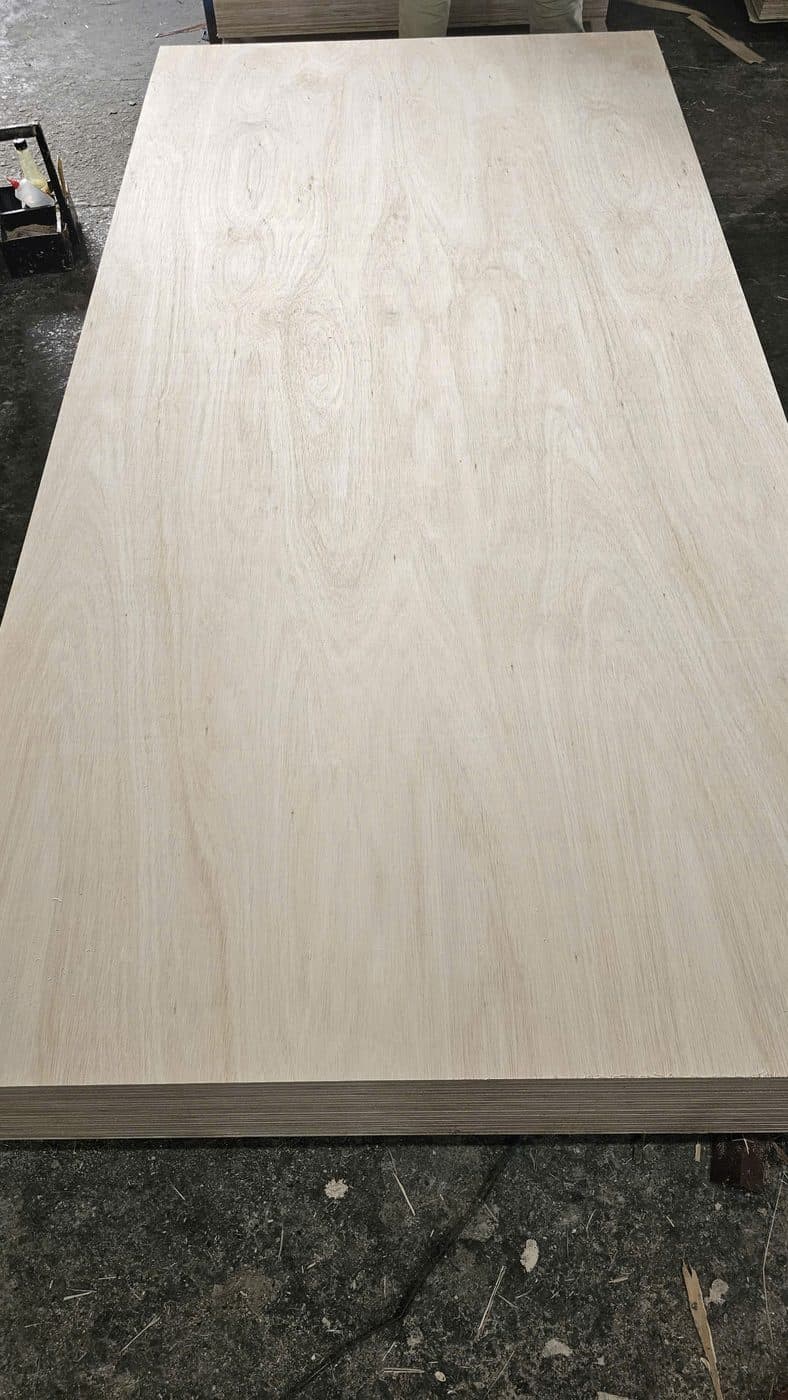
A birch face and back over a plantation acacia or eucalyptus core gives you the birch appearance, the sanding behaviour and the finishing characteristics your line is set up for, at a landed cost below both alternatives. What it does not give you is a birch edge or full-birch stiffness. If the part is painted, laminated, edge-banded or hidden, that difference costs you nothing.
The documentation position is the real argument. Plantation acacia and eucalyptus in Vietnam sit on registered smallholder plots with land-use certificates and harvest records. That is the material EUDR was written for, and it is the reason a birch-faced Vietnamese panel can carry a plot-level data pack that a re-exported birch panel cannot.
Route 4 — change the species
Underrated, and sometimes the correct engineering answer. Okoume gives a lighter panel with a smooth face for painted work. Poplar core with a hardwood face is cheaper and flatter for large flat components. Eucalyptus faces take stain acceptably for interior joinery. If your customer's specification says birch only because someone wrote it in 2018, a sample and a test batch is a cheaper conversation than three years of allocation.
Questions buyers ask about this
Is birch from Kazakhstan or Mongolia a legal workaround for sanctions?+
Kazakhstan and Mongolia do have genuine birch forest and genuine production, so the material can be legitimate. The problem is that these routes are also used to relabel Russian birch, and you as the importer carry the burden of proving which one you bought. Ask for plot-level origin evidence, not a certificate of origin — a certificate of origin only states where the panel was pressed.
How much cheaper is a birch-faced panel than full birch?+
The gap moves with veneer prices, so we will not publish a percentage that will be wrong next quarter. What is structural rather than seasonal: in a birch-faced panel only the two face plies are imported material, in full birch multiply every ply is. Ask for both quotes on the same day against the same size and thickness and the gap will be obvious.
Will a birch-faced panel pass my customer's inspection?+
If the specification describes the finished appearance, usually yes. If it names the construction — 'all-birch plies' — then no, and no supplier should tell you otherwise. Get the specification amended before you order, or order the construction it names. Substituting construction and hoping nobody cuts a panel is how a container becomes a claim.
Compare birch constructions and request samples
Get startedRead next
LELOI EXIM GLOBAL CO., LTD · Tax ID 2802935153