Birch Plywood from Vietnam — three constructions, one honest specification.
Birch face and back over a plantation core, combi core with birch cross-bands, or full birch multiply. Produced at our affiliated mills in Bac Ninh, Thanh Hoa, Hai Phong, Ho Chi Minh City, Vietnam, and shipped with plot-level origin documentation — because after the sanctions, where the birch came from is the part your compliance team has to defend.
Most price differences you see are construction differences
Vietnam has no birch forest — every gram of birch here is imported veneer or lumber. So there are exactly three honest ways to build a birch panel, and knowing which one you are being quoted explains most of the gap between two offers.
Birch face & back
The volume specification
Rotary-cut birch veneer on both faces over a plantation acacia or eucalyptus core. You get the birch appearance, the sanding behaviour and the finishing characteristics your line already runs, at the lowest landed cost of the three. The core shows at the edge, so this is the specification for painted, laminated, edge-banded or hidden work.
Plantation acacia / eucalyptus, 620–680 kg/m³
Combi core
When the edge is visible
Birch cross-bands placed directly under the face clean up the visible edge and stiffen the panel. A middle position that solves the edge problem without importing every ply. Typically a 12–18% step above a birch-faced panel, and for most cabinet work it reaches the same visible result as full birch at a lower cost.
Birch cross-bands + plantation hardwood centre
Full birch multiply
Comparable to Baltic birch
Every ply birch, built from imported birch veneer. This is the only one of the three that is genuinely comparable to Baltic birch, and it is priced accordingly because all the material is imported. Lead time follows veneer availability rather than our press schedule — we tell you the veneer origin before you order.
All-birch plies, imported veneer
What we can actually build
Copy these lines into your enquiry and send the same sheet to every mill. Six lines — size, thickness, construction, grade, glue and destination market — remove most of the noise from a price comparison.
- Panel sizes
- 1220×2440 mm · 1250×2500 mm · 1200×2400 mm · cut sizes on request
- Thickness
- 3–25 mm (nominal; tolerance stated in mm on the quotation, not implied by grade)
- Face grades
- D/E · C/D · D+/D for furniture work · BB/CP available on full birch multiply
- Face veneer
- Rotary-cut birch, 0.3–0.6 mm — specify which, it changes sanding tolerance
- Glue
- MR · melamine-fortified MR · WBP (phenolic) — bonding class 3 to EN 314-2 on the PF line
- Emission
- E1 · E0 · CARB Phase 2 / TSCA Title VI for US-bound panels
- Core
- Plantation acacia or eucalyptus · combi with birch cross-bands · full birch
- Sanding
- Calibrated and sanded both faces as standard; one-face or unsanded on request
Our mills, our panels, our containers
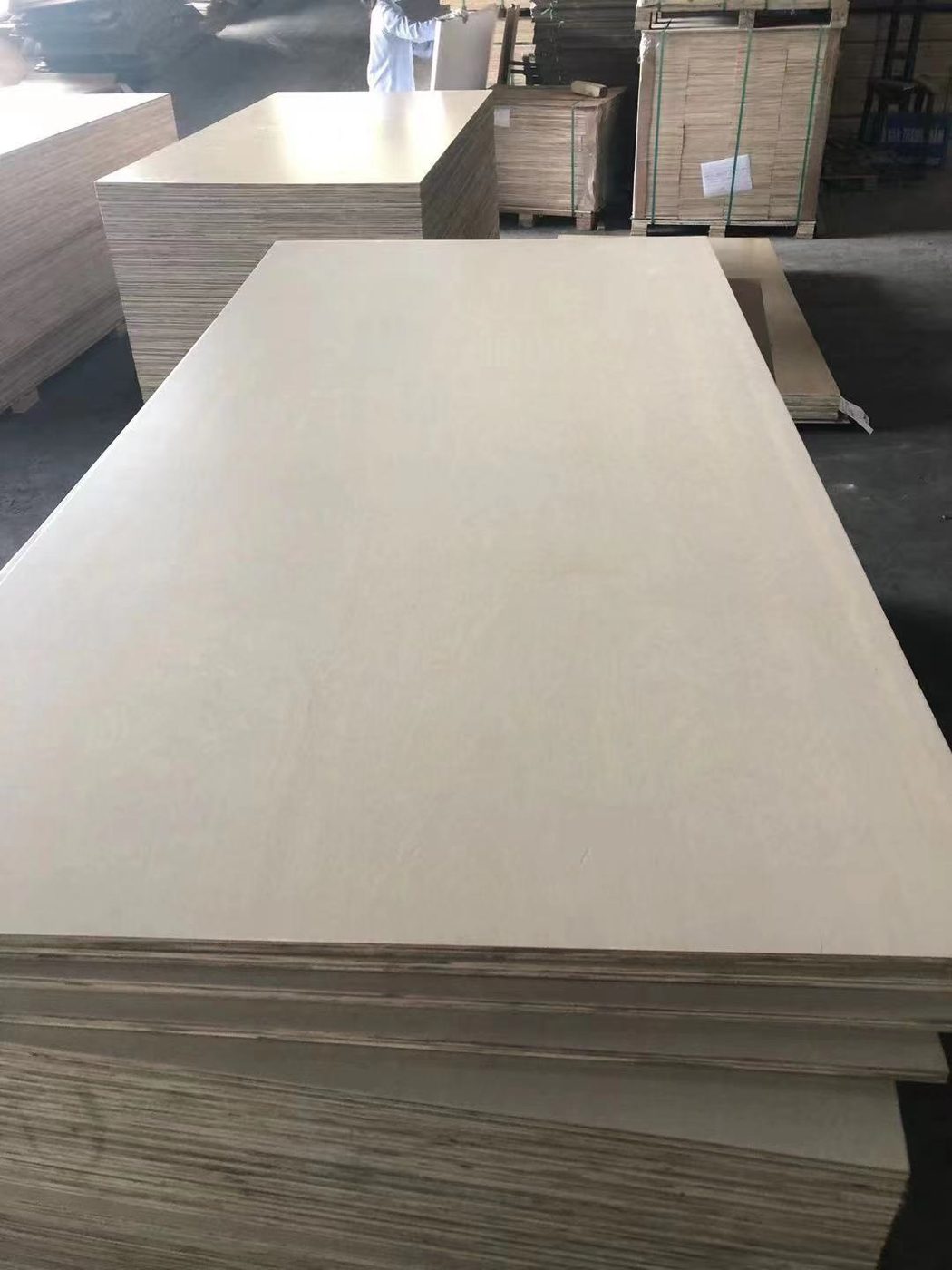
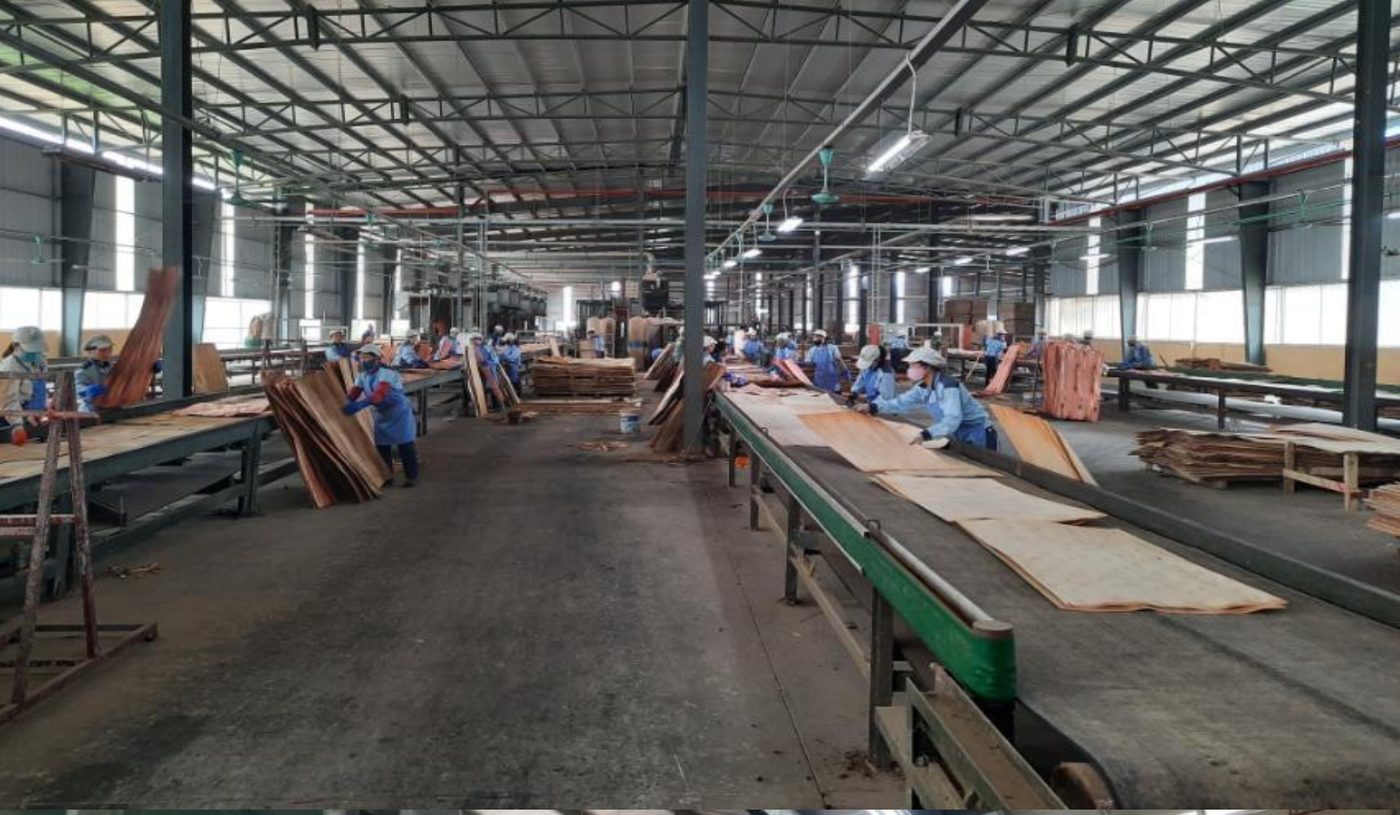
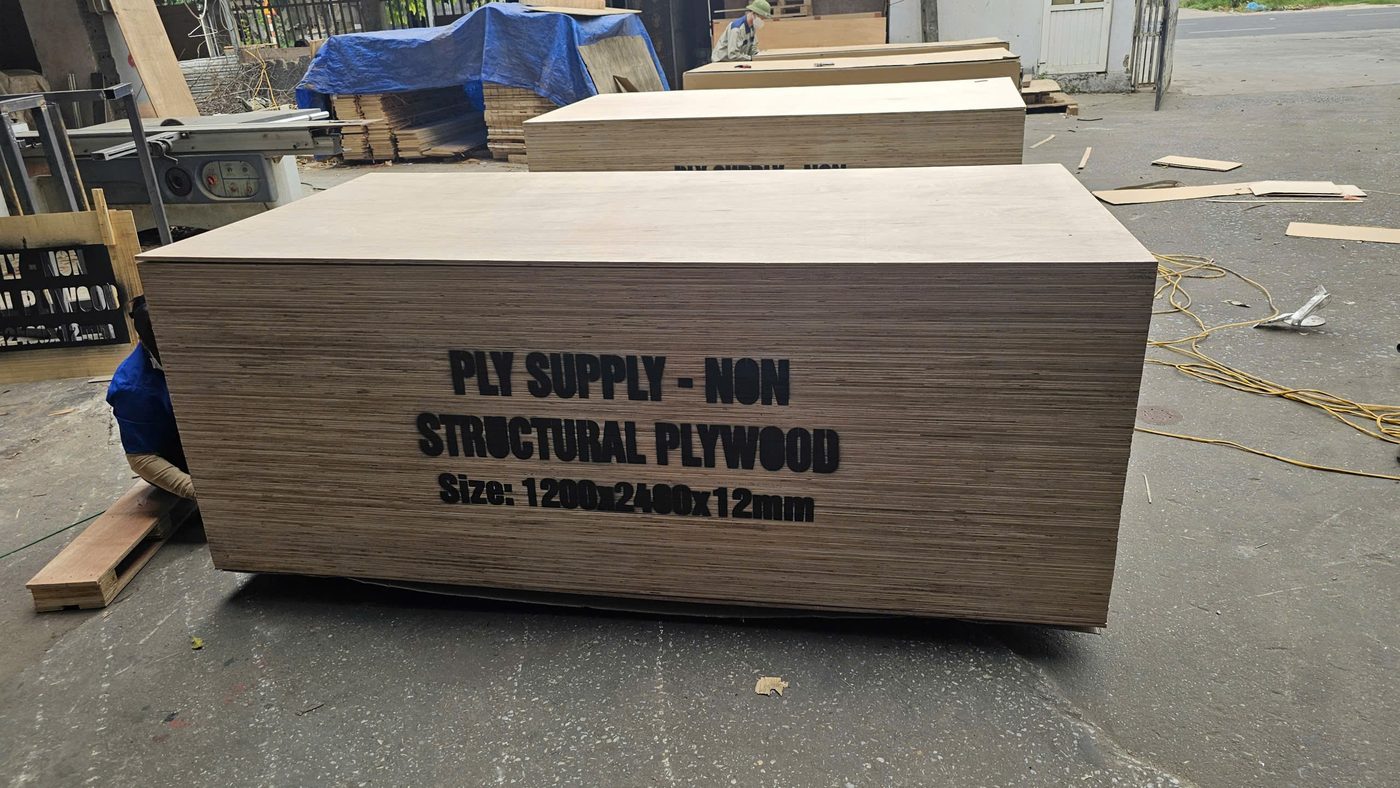
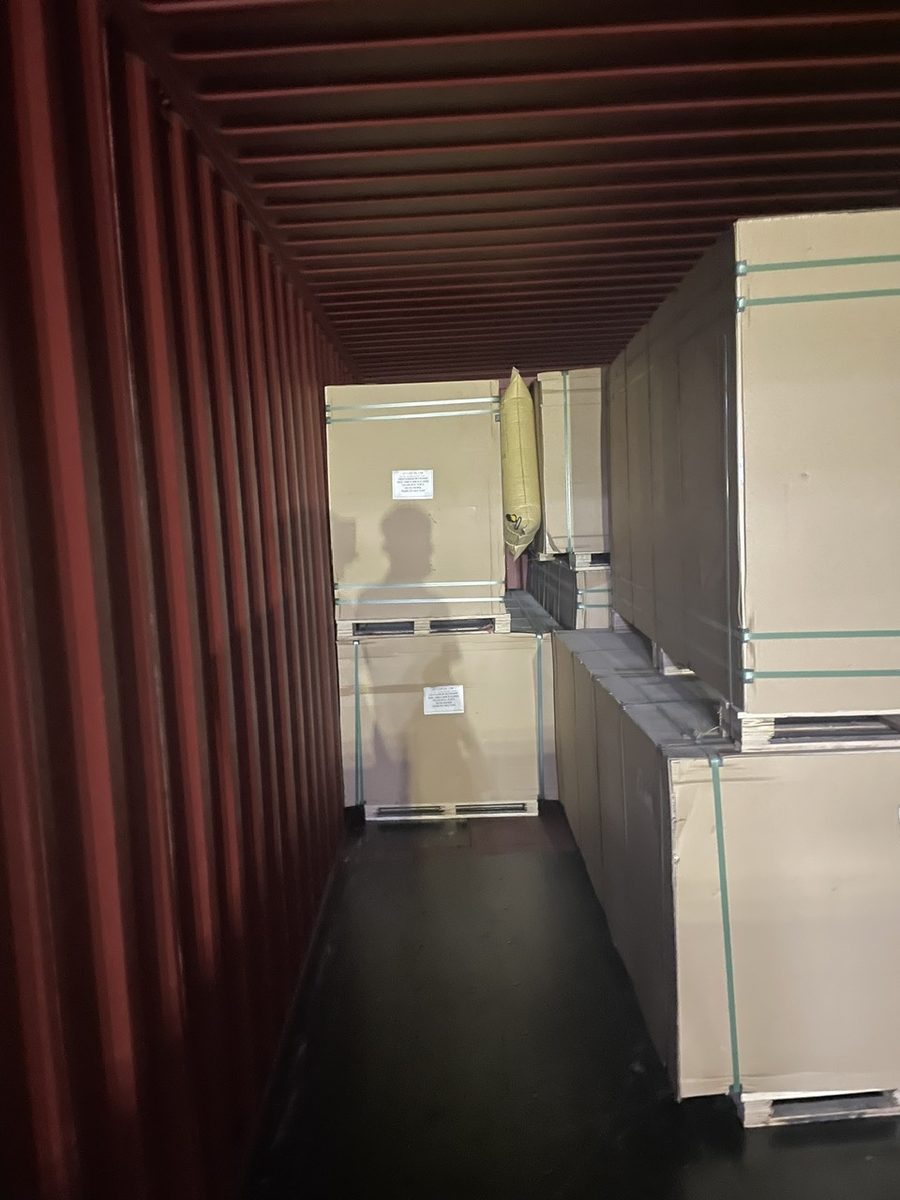
Photographs from the production floor and the loading bay. Ask for a live video walkthrough of the press line at short notice — we schedule those on request.
Numbers with the reference next to them
Every figure below carries a certificate or report number you can check. Ask for any of them and we send the document that covers the product it applies to.
- Formaldehyde (US)
- CARB/EPA 21023 · ICTT Corporation TPC-43 · HWPW-VC 2–21 mm, 3–13 plies Valid to 25 May 2027
- Formaldehyde (chamber)
- 0.05 mg/m³ measured — the E1 limit is 0.124 mg/m³ SGS VNHL2606013466HG · 16 Jun 2026
- Bond quality
- Class 3 — exterior, phenolic (PF) resin EN 314-2 · HJ-RD-25039
- Bending strength (MOR)
- 66.0 N/mm² parallel · 54.7 N/mm² perpendicular EN 310 · HJ-RD-25039
- Origin documentation
- Plot coordinates, land-use basis, species and harvest period for the plantation core GeoJSON + legality folder per shipment
- Imported components
- Birch veneer origin documents passed through and labelled as supplier-provided Never presented as first-party evidence
What covers your order
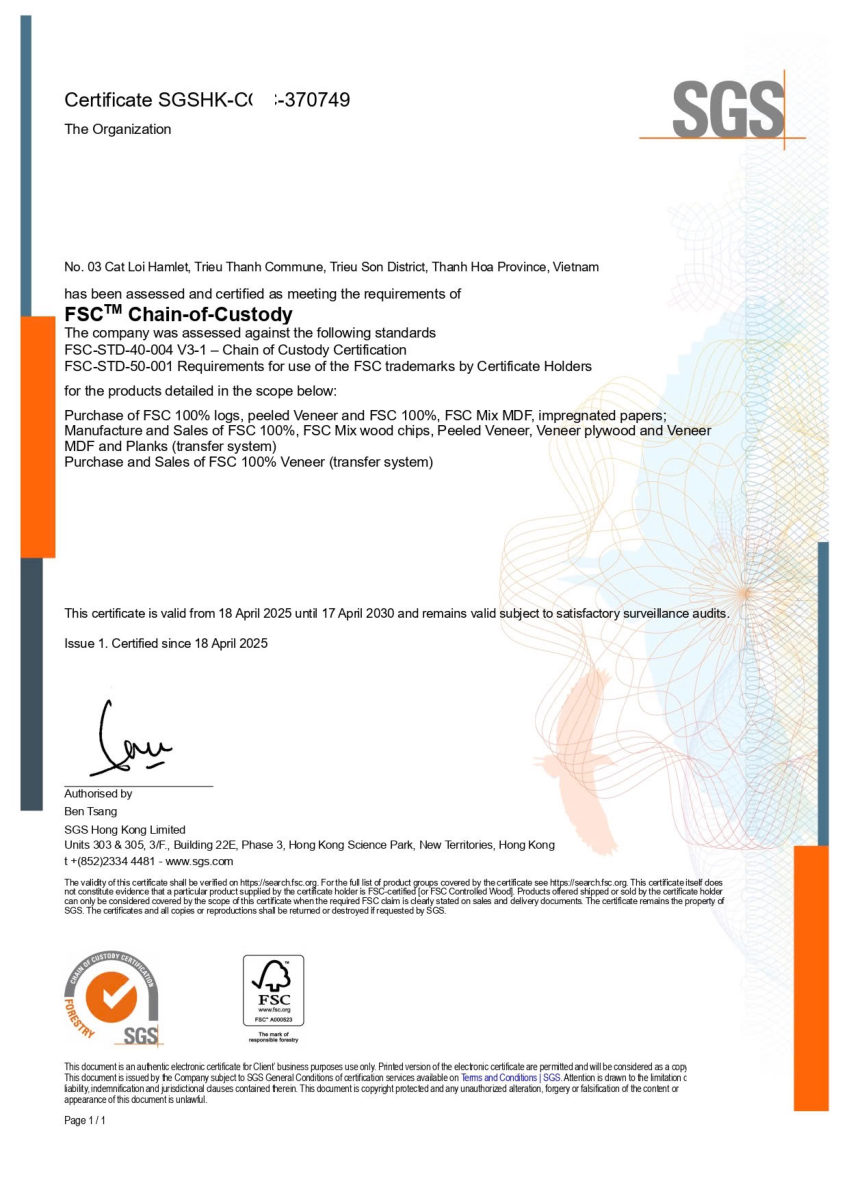
FSC Chain-of-Custody
Valid to 2030-04-17
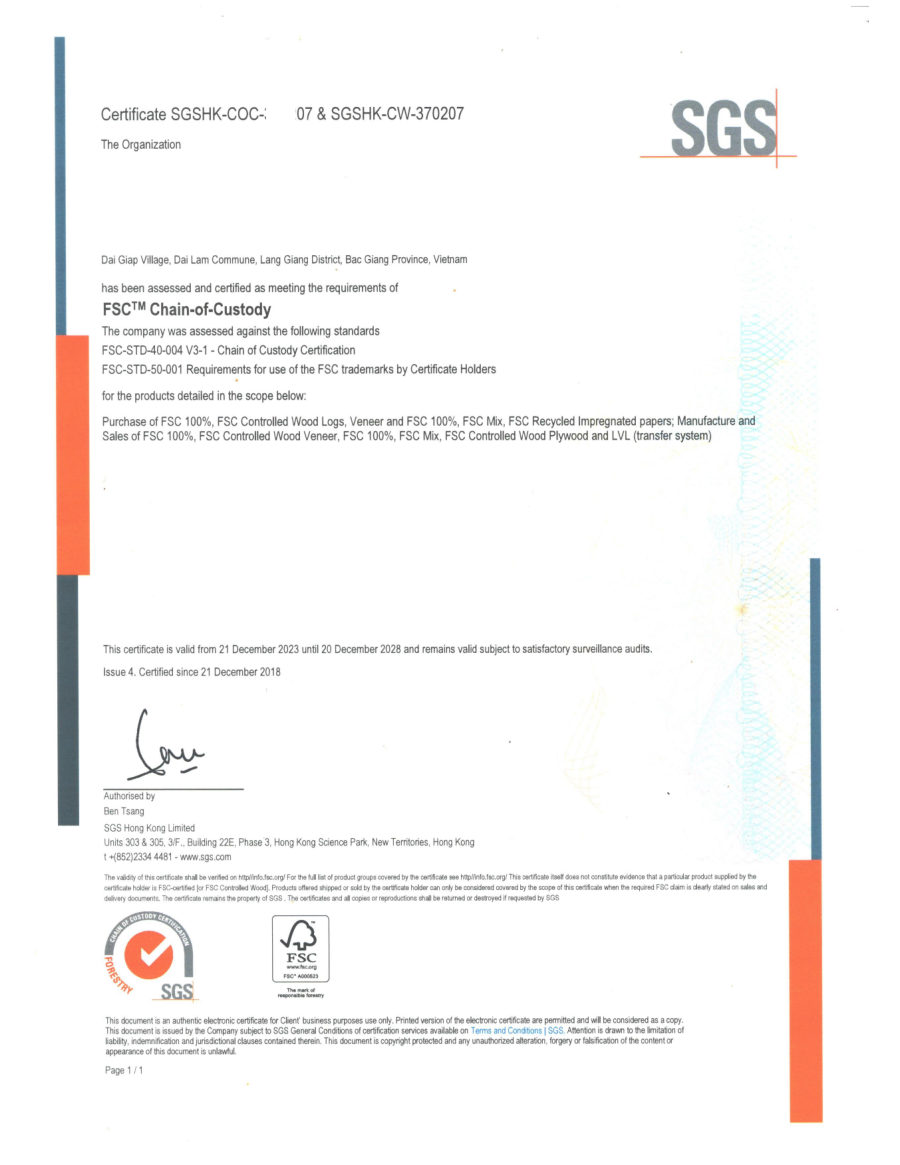
FSC Chain-of-Custody
Valid to 2028-12-20
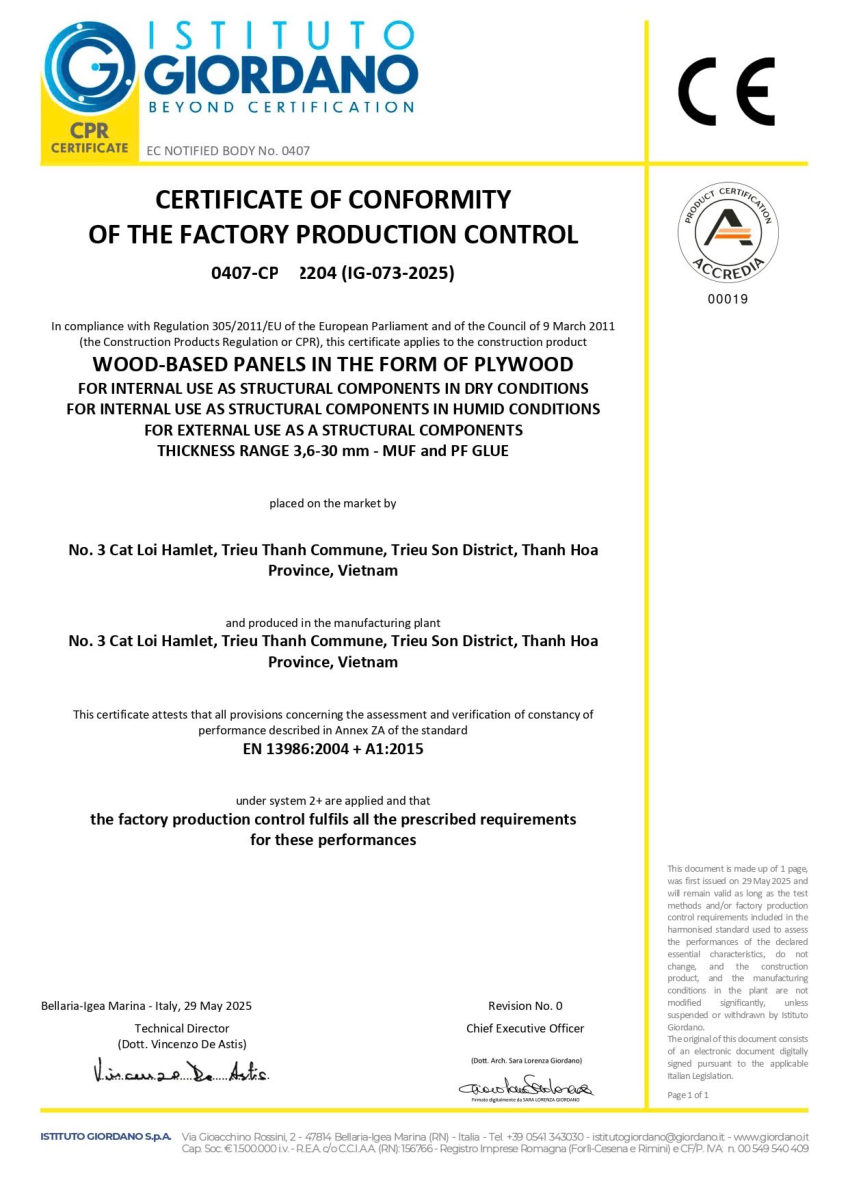
CE — EN 13986 plywood
Valid to 2028-05-28
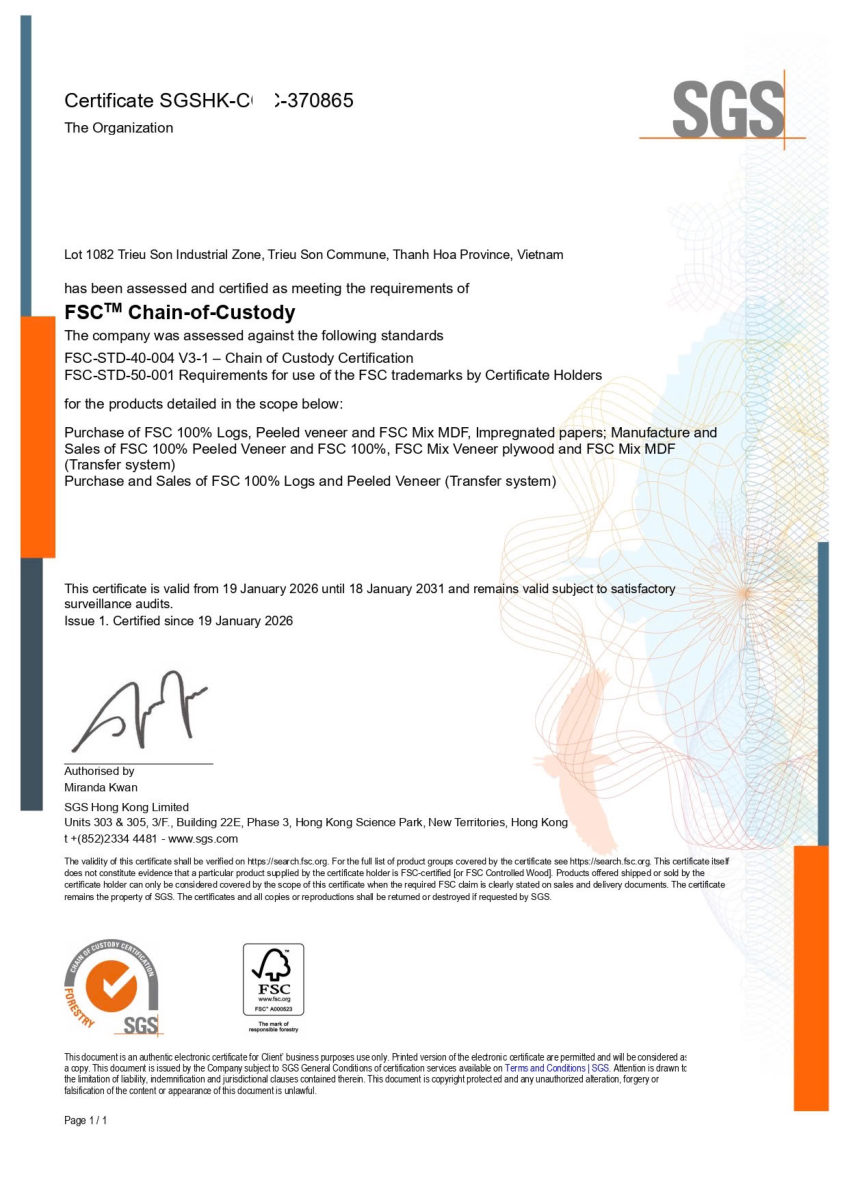
FSC Chain-of-Custody
Valid to 2031-01-18
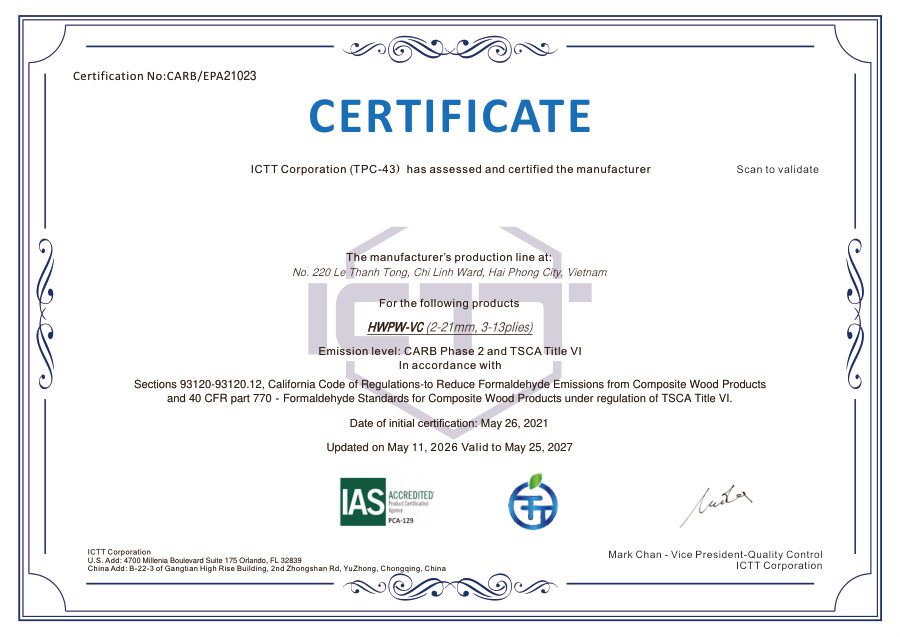
CARB Phase 2 / TSCA Title VI
Valid to 2027-05-25
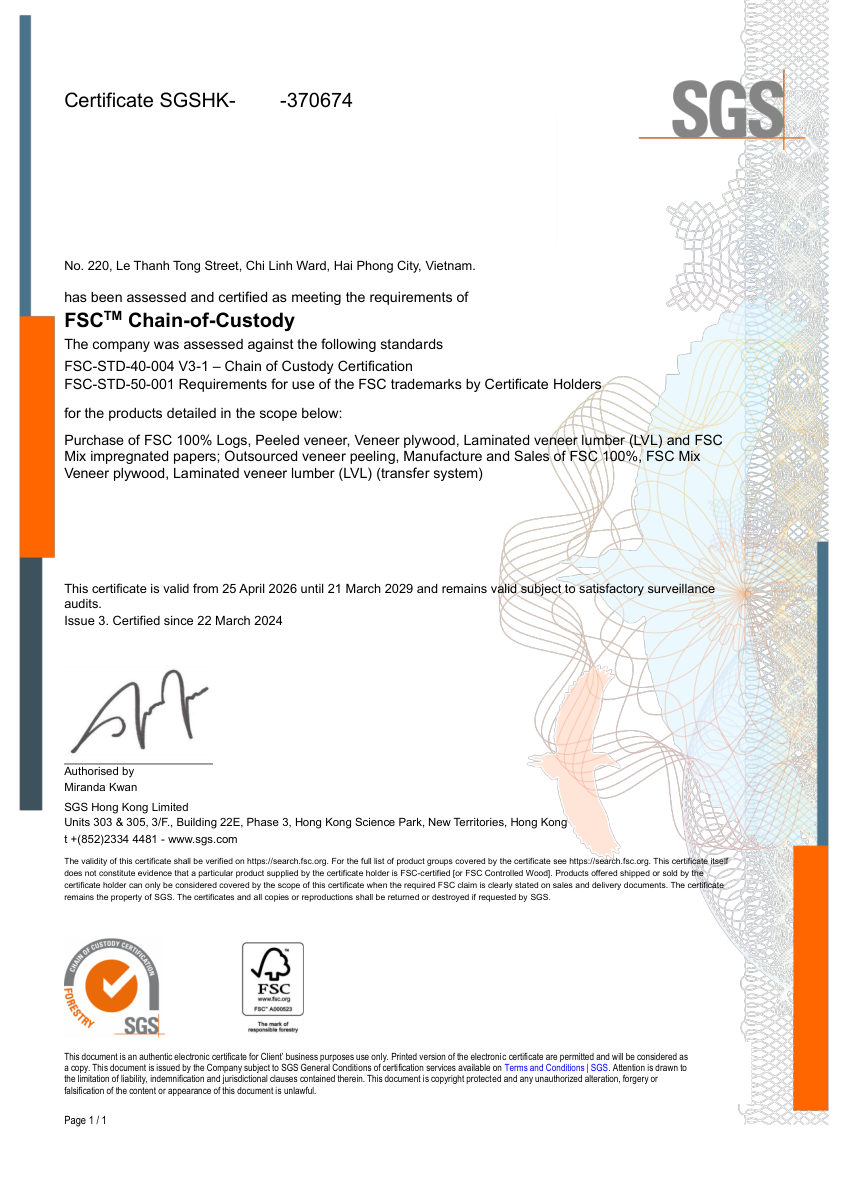
FSC Chain-of-Custody
Valid to 2029-03-21
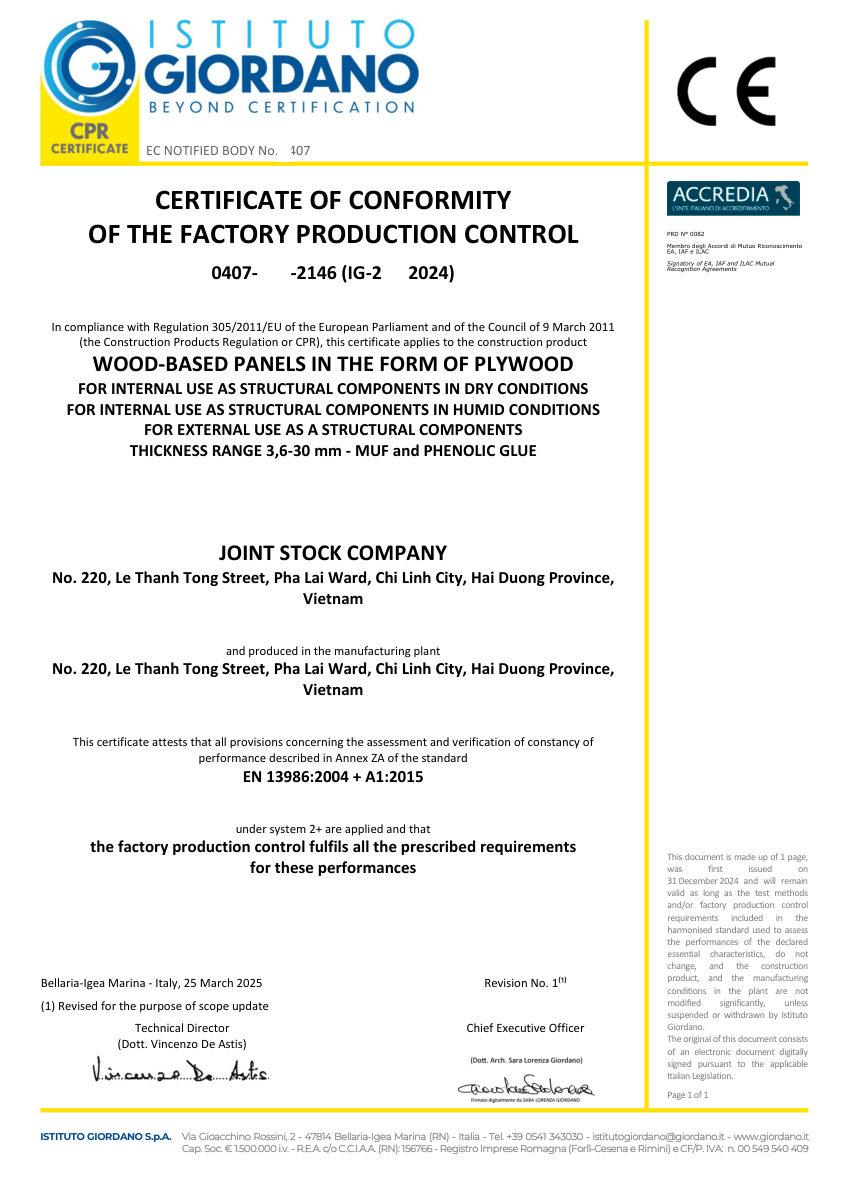
CE marking — EN 13986
Condition-based validity
Certificates are issued to the producing mill and to specific product families. We send the documents that cover the panels in your order, not a generic bundle.
The plantation core is documented to the plot
Acacia and eucalyptus grown on registered smallholder plots with land-use certificates and harvest records. We supply plot coordinates as GeoJSON, species by scientific name, harvest period, and a volume reconciliation from plot to container — the evidence an EU operator needs to file a Due Diligence Statement, and the species and origin data a US importer needs for a Lacey Act declaration.
The imported birch is labelled as imported
Birch veneer and birch lumber come from outside Vietnam, so we cannot generate first-party evidence for them and we do not pretend to. You get the origin documentation we received from the veneer supplier, clearly marked as pass-through, plus our own assessment of that supplier. If you need a specific documented origin — Canadian or North American birch, for example — say so and we will price it.
Send the panel you buy today. We quote the same thing.
Construction, face and back grade, size, thickness, glue and destination market. A like-for-like comparison is the only one worth making — and if a birch-faced panel will not do what your part needs, we will tell you to buy full birch instead of selling you the cheaper one.
Questions birch buyers ask
Is Vietnamese birch plywood the same as Baltic birch?+
No. Baltic birch is full birch multiply cut from cold-climate birch forest, and Vietnam has no birch forest — every gram of birch in a Vietnamese panel is imported veneer or lumber. What we build is a birch face and back over a plantation hardwood core, a combi core with birch cross-bands, or full birch multiply from imported veneer. Only the third is comparable, and it is priced accordingly. Any supplier telling you their Vietnamese panel equals Baltic birch has told you something you can check by cutting one.
What do D/E, C/D and D+/D actually mean?+
Face first, back second. D/E is a working panel with the highest patch tolerance, for painted, laminated or hidden work. C/D is a presentable face over a rougher back, for cabinet interiors and shop fittings. D+/D is a compromise where both sides are semi-visible. Grade letters are not an international standard — two mills can call the same panel C/D and D+/D — so we send physical face samples before a first order and sign one as the contractual standard.
Are the panels CARB Phase 2 and TSCA Title VI certified?+
Yes. Certificate CARB/EPA 21023 through ICTT Corporation (TPC-43) covers HWPW-VC hardwood plywood from 2 to 21 mm, 3 to 13 plies, valid to 25 May 2027. It is issued to the producing mill, so we send you the certificate covering the panels in your order rather than a generic copy. Check three things on any certificate: that it names the mill that pressed your panels, that it covers your thickness and ply count, and that it was current on the date of manufacture.
What origin documentation comes with the panels?+
For the plantation core we supply first-party evidence: plot coordinates in GeoJSON, the land-use basis for each plot, species by scientific name, harvest period, and a volume reconciliation from plot to container. For imported birch veneer we pass through the origin documentation received from the veneer supplier and label it as exactly that. We do not present supplier documents as our own — that is the kind of paperwork that fails an EU operator's review, and it would fail yours too.
What is the minimum order and the lead time?+
One 40ft high-cube per specification for a first order — roughly 22–24 m³ of panels depending on thickness, because plywood reaches the container weight limit long before the volume limit. Mixed containers of two or three thicknesses in the same construction work well. Lead time is 20–25 days from confirmed order to loading for a standard specification, plus about a week if the face grade or construction is new to us.
Can you source Canadian or North American birch for the faces?+
Yes, and it is worth discussing if your buyer needs a documented Western origin for the birch itself. Canadian yellow and white birch already moves to Vietnamese factories as kiln-dried lumber under HS 4407.96 at around 495–555 USD/m³ — upper-tier hardwood pricing, so the panel costs more and the argument for it is documentation rather than price. Tell us the origin your customer requires and we will cost it against a standard birch-faced panel so you can see the difference before deciding.
Request a specification-matched quote
Two minutes to fill in · we reply within 24 hours with price, lead time and the certificates that cover the product.
LELOI EXIM GLOBAL CO., LTD · Tax ID 2802935153. Test results refer to the samples tested and to the products those reports cover. Classification and duty treatment of any shipment are determined by the importer and their customs broker.