Short answer
Northern Vietnam around Hai Phong, Bac Giang and Phu Tho is the volume cluster: acacia and eucalyptus plantations, film-faced and packing plywood, deep-sea port access. The central region around Thanh Hoa, Nghe An and Quang Ngai supplies raw material and increasingly finished panels. The south around Binh Duong and Dong Nai is furniture-driven with more veneering and finishing capability. Lead time for a standard specification runs 20–25 days from confirmed order to loading, plus one week for a new construction. Price is built from log cost, veneer recovery, glue, film or overlay, press time and packing — ask a supplier to break those out and you learn quickly whether you are talking to a mill or a trader.
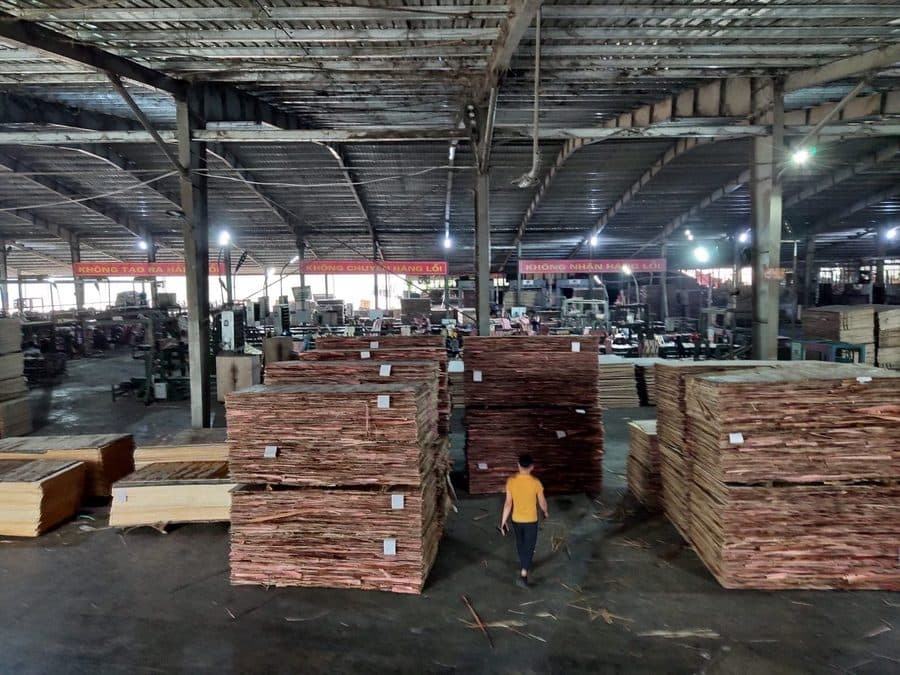
Am I talking to a mill or a trader?
Both are legitimate and both have a role — a good trader consolidates small orders and manages several mills so you do not have to. The problem is not the trader, it is not knowing. A trader who says 'our factory' when they mean a mill they buy from cannot give you certificates in the right name, cannot give you plot data, and cannot fix a production problem at three in the morning.
Three questions settle it. Which legal entity holds the CARB or CE certificate, and is it the entity on my invoice? Can you send a video call from the press line this week? What is the tax code of the producing factory? Nobody who owns production hesitates on any of the three.
What actually drives the price?
Log cost and veneer recovery dominate. Plantation acacia is bought by weight at the mill gate and its price moves with harvest cycles and with chip demand from the pulp sector, which competes for the same wood. Recovery rate — how much usable veneer comes off a log — separates a well-run mill from a struggling one by several percent, and several percent of the largest input is the whole margin.
After that: glue chemistry, film or overlay weight, press cycle time, sanding passes, and packing. Freight and the exchange rate sit on top and move independently of the mill. When a quotation drops sharply between two suppliers, one of these lines changed — ask which one rather than assuming you found a better negotiator.
How should I plan lead time around the calendar?
Two dates dominate the Vietnamese year: Tet, which stops production for one to two weeks and disrupts labour for two more, and the pre-Christmas European shipping peak, when space and equipment tighten. A quotation given in September for December delivery that ignores both is a quotation given by someone who will be apologising in November.
- Standard specification in production: 20–25 days to loading
- New construction or first-time face grade: add 7 days for sample approval
- New moulding profile: add 14 days for tooling
- Tet and pre-Christmas peak: add buffer, do not compress
Questions buyers ask about this
Is Vietnamese plywood cheaper than Chinese?+
Not reliably, and price is usually not why buyers move. What moves buyers is trade exposure, origin documentation and supply security. Compare landed cost including duty and the cost of the compliance work you will do at your end, not the FOB sheet price, and the comparison will look different from the one on the first email.
Can I visit the factory before ordering?+
Yes, and you should if the volume justifies the flight. If it does not, a scheduled live video walkthrough covering the log yard, the press, the sanding line and the packing area answers most of the same questions. We arrange these on request; a mill that will not is telling you something.
What is a realistic first order?+
One 40ft high-cube of a single specification, or a mixed container of two to three thicknesses in the same construction. Small enough to limit exposure, large enough that the freight per sheet makes sense and the mill treats it as a real order rather than a sample run.
Send your specification for a quote
Get startedRead next
LELOI EXIM GLOBAL CO., LTD · Tax ID 2802935153