Short answer
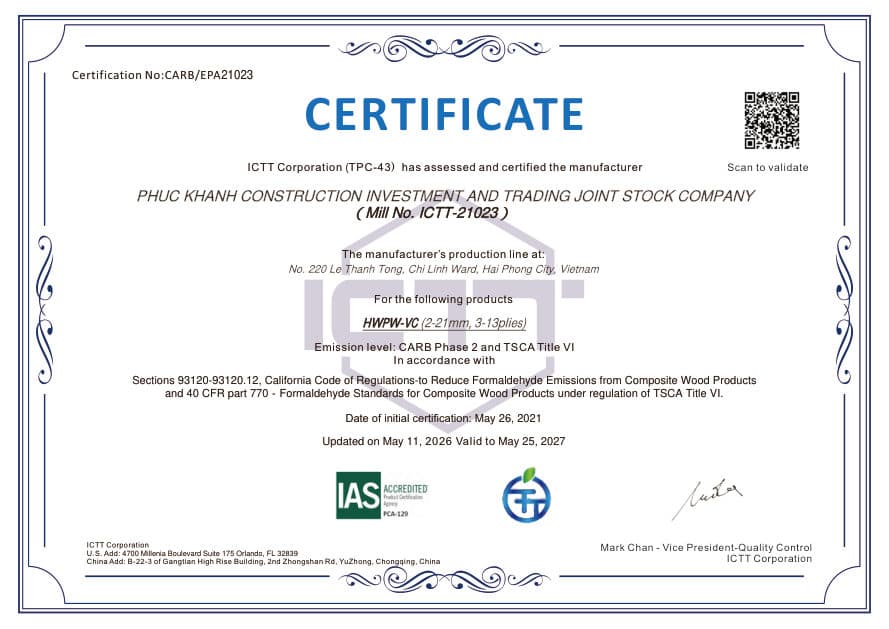
TSCA Title VI sets federal formaldehyde emission standards for composite wood products sold in the United States, aligned with California's CARB Phase 2. Compliance requires certification by an EPA-recognised Third-Party Certifier (TPC), panel or bundle labelling that identifies the producer and the TPC, and importer records demonstrating due care. Our partner mill holds certificate CARB/EPA 21023 through ICTT Corporation (TPC-43), covering HWPW-VC hardwood plywood from 2 to 21 mm and 3 to 13 plies, valid to 25 May 2027. Verify three things: that the certificate names the producing mill, that it covers your thickness and ply count, and that it is current on the date of manufacture — not the date of the quotation.
Who carries the compliance obligation?
The importer. Under the rule, importers must exercise due care and be able to produce records showing the panels they brought in were certified compliant at the time of manufacture. A supplier's assurance is not a defence; the certificate covering the specific product is. This is why the certificate has to name the producing mill rather than a trading company.
A common failure is a certificate held by a trader who buys from three mills. It covers panels from one of those mills and says nothing about the other two, and the importer discovers which one only when the shipment is tested. Ask which mill pressed your panels, then match the certificate to that mill.
What should the labelling look like?
Panels or bundles must carry a label identifying the panel producer, the date of production expressed at least as month and year, the TPC number, and a statement that the product is TSCA Title VI compliant. The label needs to survive shipping, which in practice means printed on the bundle wrap and stencilled on panel edges rather than a paper tag that arrives in the bottom of the container.
How does this interact with Lacey Act and EUDR?
They are three separate regimes answering three different questions. TSCA Title VI asks what the panel emits. The Lacey Act asks whether the wood was legally harvested and requires a plant declaration on import. EUDR asks whether the land was deforested after 31 December 2020 and requires geolocation. A supplier can be excellent at one and blank on the others, so audit them separately rather than accepting a general compliance claim.
Questions buyers ask about this
Is E1 the same as TSCA Title VI compliant?+
No. E1 is a European emission class measured by a different method and does not confer US compliance. TSCA Title VI compliance requires certification by an EPA-recognised third-party certifier against the US emission limits and test methods. A panel can meet E1 and still be non-compliant for US import.
What records should I keep as the importer?+
The producer's certificate valid at the date of manufacture, the commercial invoice and packing list identifying the panels, photographs of the labelling on the actual shipment, and your correspondence establishing the panel construction. Keep them for the retention period applicable to your entries and store them so a compliance query three years later is a search, not an investigation.
Do exempt or de minimis products exist?+
The rule contains specific exemptions and definitions, and whether your product falls inside them is a determination for your customs broker and counsel against the current text — not something a supplier should decide for you. Where there is doubt, buying certified product costs less than being wrong.
See certificates covering US-bound panels
Get startedRead next
LELOI EXIM GLOBAL CO., LTD · Tax ID 2802935153