Short answer
A 20ft container has roughly 28 m³ of usable space but a payload limit around 21–22 tonnes, so plywood at 600–700 kg/m³ hits the weight limit at about 25–27 m³ of panels — the 20ft is a weight-limited box. A 40ft high-cube has about 68 m³ usable and a payload around 26–27 tonnes, so you reach the weight limit at roughly 22–24 m³ of solid panel stacks and the remaining space goes unused. This is why most plywood ships in 40ft high-cubes loaded to weight, not to volume, and why mixing thicknesses is worth planning.
Why does the weight limit bite before the space runs out?
Because plywood is dense and stacks with almost no void. A hardwood-core panel runs 620–700 kg/m³ and a pallet of panels is effectively solid wood. Multiply 24 m³ by 680 kg/m³ and you are at 16.3 tonnes of product before pallets, packaging and the weight of the container itself enter the calculation — and road weight limits at the destination often bite before the shipping line's limit does.
Thickness changes the arithmetic. Thin panels of 3–6 mm give you more square metres per tonne, so a container of 4 mm packing board carries far more surface area than a container of 18 mm formwork even though both weigh the same. Price per sheet and price per cubic metre tell different stories; make sure you and your supplier are quoting the same one.
How should the container actually be packed?
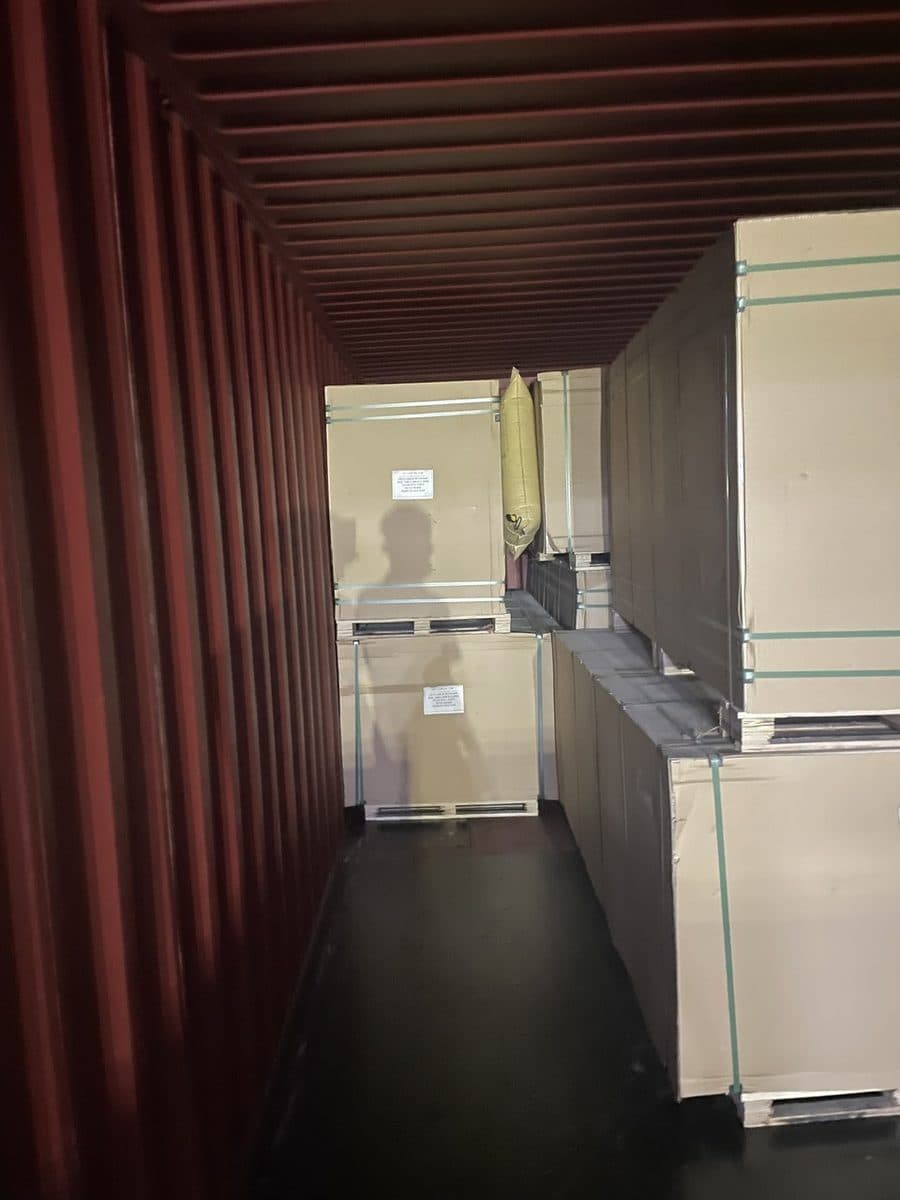
Panels flat, banded into bundles, with edge protectors on the corners and moisture-barrier film over the stack. Bundles sit on bearers so a forklift can lift them without damaging the bottom sheet. Weight is distributed evenly along the container floor rather than concentrated at the door end, which matters for road transport at the destination and for the container's own certification.
Ask for loading photographs before the doors close — not a stock photo, the actual container with your booking number visible. We photograph every load as standard, which is a habit worth requiring from any supplier because it makes damage disputes resolvable instead of endless.
What about mixed-thickness and mixed-product containers?
Usually a good idea and always worth asking for. Combining thick and thin panels lets you reach the weight limit and the volume limit at the same time, which is the cheapest freight you will ever buy. The constraint is production scheduling: three thicknesses on the same press run is straightforward, three different constructions is not.
Questions buyers ask about this
Can you load a 40ft high-cube to full volume?+
Only with light cargo. With plywood you will reach the payload limit with roughly a third of the volume unused, and a supplier who promises 68 m³ of panels in a 40HQ is describing an overweight container that the port will not accept. Plan to weight, and use the leftover space for lighter items if you are shipping mixed products.
Do I need ISPM-15 treatment?+
Plywood itself is a processed panel and is generally exempt because the manufacturing process eliminates pests. The wooden bearers, pallets and crating that travel with it are not exempt and must be ISPM-15 heat-treated and marked. This catches people out: the cargo is compliant and the dunnage is not.
How long from order to loaded container?+
For a standard specification already in production, 20–25 days from confirmed order and deposit to loading. A new construction or a first-time face grade adds a week for sample approval. Peak season before Tet in Vietnam and before Chinese New Year compresses everyone's schedule — book earlier rather than accepting a promise that ignores the calendar.
Get a loading plan for your specification
Get startedRead next
LELOI EXIM GLOBAL CO., LTD · Tax ID 2802935153