Short answer
EUDR is Regulation (EU) 2023/1115. It does not create a certificate. It creates an obligation: before a product enters the EU market, the EU operator or importer must file a Due Diligence Statement in the EU Information System, declaring the geolocation of every plot the goods came from, the production period, and evidence that the land was not deforested after 31 December 2020 and that production was legal in the country of origin. As a Vietnamese exporter you do not file that statement — you supply the data behind it. Large and medium operators must comply from 30 December 2026; micro and small enterprises from 30 June 2027.
Why do so many Vietnamese companies think they need an EUDR certificate?
Because that is how every previous requirement worked. ISO, FSC, CARB, CE — each one ends with a certificate you can put in a folder and email to a buyer. EUDR does not work that way, and the habit of thinking in certificates is exactly what a certain kind of service provider is selling into.
EUDR shifts the burden onto the EU company that places the goods on the market. They carry the legal liability, they file the statement, and they can be fined if the data is wrong. Which is why they push the requirement down to you: not as a certificate to obtain, but as data to hand over.
So who does what?
The EU operator or importer files the Due Diligence Statement. To do it they need an EU Login account and an EORI number, which a Vietnamese company does not have. If a service provider offers to file on your behalf, ask whose account they will file under — because the answer determines who is legally liable.
Your job is narrower and more concrete: identify every plot the goods came from, record its coordinates, prove the land was legally used, prove it was not deforested after the cut-off, and keep the paper trail that links those plots to the specific batch in the container. That is the whole job.
Which deadline applies to my company?
Under the amendment adopted in December 2025, medium and large operators and traders must comply from 30 December 2026. Micro and small enterprises — broadly, fewer than 50 employees and turnover below €10 million on in-scope products — have until 30 June 2027.
In practice the later date helps less than it sounds. Your EU buyer is usually a large company complying from the end of 2026, and they will ask for your data well before their own deadline — because they cannot file without it. Plan around your buyer's deadline, not your own.
Is my product even in scope?
EUDR covers seven commodities — cattle, cocoa, coffee, oil palm, rubber, soya and wood — plus products derived from them, listed by customs code in Annex I. For wood this reaches much further than logs and sawn timber: plywood, fibreboard, mouldings, builders' joinery, furniture, pulp and paper are all included. Printed products such as books and newspapers were removed from scope by the 2025 amendment.
The most common surprise is a company that makes finished goods — furniture, doors, mouldings, tyres, gloves — and assumes the rules only apply to raw material suppliers. They do not. If the product contains an in-scope commodity, it is in scope.
What does the 31 December 2020 cut-off actually mean?
Goods must come from land that was not deforested after 31 December 2020. It is a date about the land, not about your paperwork. Land converted from forest to plantation in 2019 is fine; the same conversion in 2022 puts everything grown there outside the EU market, even if every Vietnamese permit is in order.
This is why satellite screening early matters more than screening thoroughly. Finding a problem plot before you sign a contract costs you one supplier. Finding it after the container sails costs you the shipment and usually the customer.
What data do I actually have to collect?
Article 9 of the regulation lists it: description of the product and its customs code, quantity, country of production, the geolocation of all plots where the commodity was produced, the date or time range of production, and the name and contact of the businesses you bought from and sell to. Alongside that you need evidence of legality and evidence that the land is deforestation-free.
The words that trip people up are all plots. A container of plywood may contain veneer from dozens of separate harvests. A lot of coffee may be blended from hundreds of smallholders. Every one of those origins must be declared — which is why the practical work starts with batch records at the first collection point, not with a certificate at the end.
Where do I start if I have nothing yet?
Start with one buyer and one product line, not with your whole business. Check the customs code is in scope. List the suppliers feeding that line. Collect the coordinates already printed on their land certificates — most plots do not need a field survey. Screen those coordinates against public satellite data. Then write down, batch by batch, which plots went into which shipment.
A buyer does not expect a Vietnamese supplier to be perfect in the first year. They expect to see a system running, with names, coordinates and dates they can pass to their own compliance team. Having something real and incomplete beats having nothing and a promise.
Questions buyers ask about this
Does any organisation issue an EUDR certificate?+
No. The European Commission does not issue one and has not accredited anyone to issue one. Certification bodies can audit your traceability system and issue their own scheme certificate, which is useful supporting evidence — but it is not an EUDR certificate and it does not replace the due diligence statement.
We have FSC certification. Is that enough?+
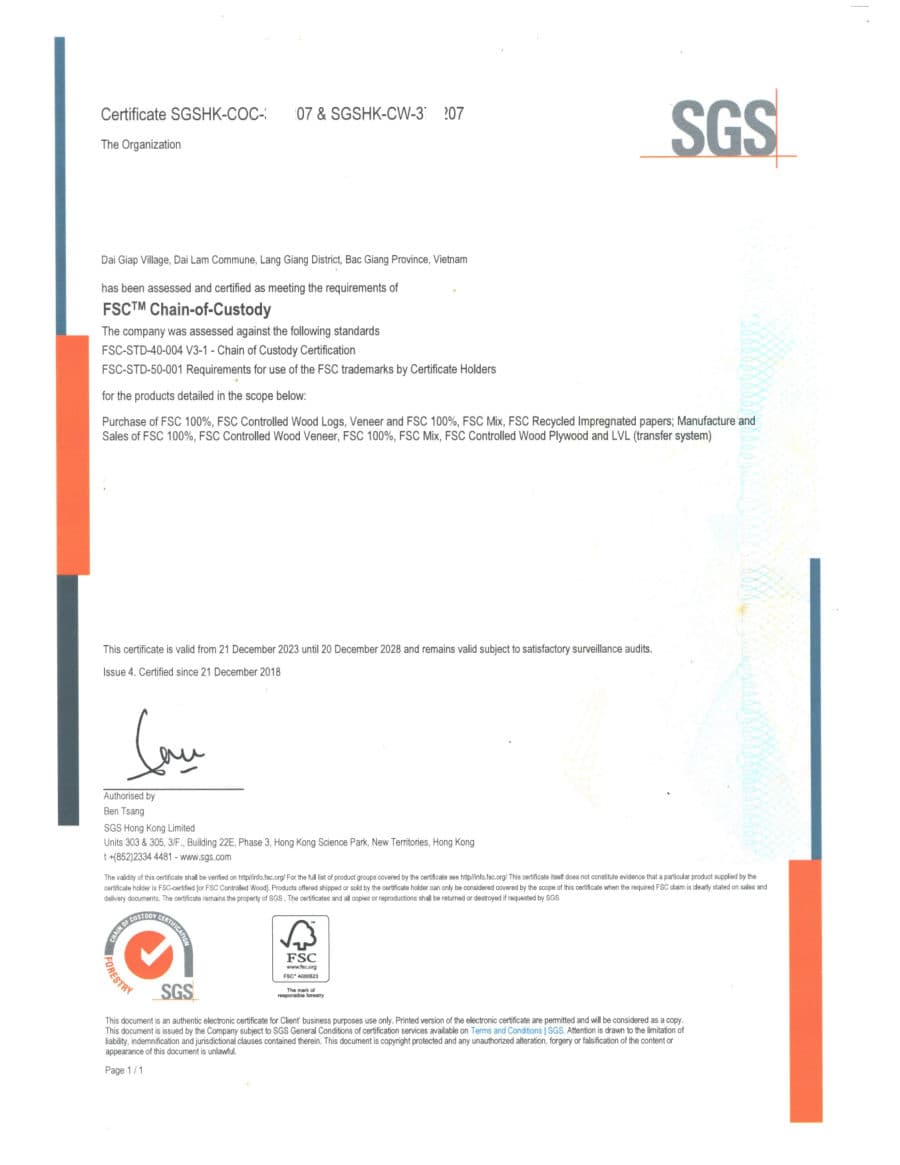
No. FSC demonstrates sustainable forest management and chain of custody, which helps, but EUDR asks a different question: the geolocation of each plot and whether that specific land was deforested after 31 December 2020. Certification schemes are explicitly not treated as automatic proof of compliance.
Vietnam is classified low risk. Can we skip the paperwork?+
No. Low risk simplifies part of the risk assessment step. It does not remove the obligation to collect information, and it does not remove the geolocation requirement. Treating low risk as an exemption is one of the most expensive misunderstandings in this regulation.
Can LELOI file the due diligence statement for us?+
No, and neither can any other Vietnamese company. Filing requires an EU Login account and an EORI number held by the EU operator or importer, who carries the legal responsibility. LELOI prepares and structures the data behind the statement and hands your buyer a dossier they can file from.
Do we need a field GPS survey for every plot?+
Usually not. Most plots already have coordinates printed on the land certificate or cadastral extract, and those can be converted to polygons directly. A field survey is only needed for plots with no document describing their boundary.
What happens if one plot turns out to be non-compliant?+
That plot is excluded from EU-bound lots. Your company is not banned. The damage depends entirely on when you find out — before contracting, you lose one source; after the container sails, you lose the shipment and usually the relationship.
How much does it cost to get started?+
On the LELOI platform your first two suppliers are free: you declare the data yourself, run the satellite screening, generate a draft statement and share a buyer portal link. Beyond that a plan applies. Field GPS surveys, where genuinely needed, are quoted separately by location.
Check whether your customs code is in scope — free
Get startedRead next
LELOI EXIM GLOBAL CO., LTD · Tax ID 2802935153