Short answer
Under Regulation (EU) 2023/1115 the EU operator placing plywood on the market files the Due Diligence Statement and holds the legal exposure — not the Vietnamese mill. To file, you need geolocation of every plot the wood came from, the production period, species, quantity, evidence of legal harvest under Vietnamese law, and an unbroken paper trail linking those plots to the specific container. Ask for these five things by name, ask for a past shipment's file rather than a promise, and check whether the mill can distinguish first-party evidence it controls from supplier-provided documents it merely passes through. Medium and large operators comply from 30 December 2026; micro and small from 30 June 2027.
Why can't I just accept an 'EUDR certificate' from my supplier?
Because no such certificate exists. The EU does not issue one and has not authorised anyone to issue one. If a Vietnamese supplier sends you a document titled 'EUDR Certificate', you are looking at a commercial product invented by a consultancy, and it will not help you when a competent authority asks how you verified your due diligence.
What does help is a data pack you can defend line by line. The regulation is written around information, not around certificates, precisely so that the liability cannot be transferred to a piece of paper. Treat any supplier selling you a certificate as a supplier who has not read the regulation.
What exactly must the mill hand over?
For plantation timber — the acacia and eucalyptus that make up most Vietnamese plywood cores — the mill should be able to give you plot coordinates as points or polygons in a standard format, the land-use certificate or equivalent legal basis for each plot, harvest permits or the smallholder equivalent, species declared by scientific name, and volumes reconciled from plot to log yard to press to container.
For imported components — birch veneer, radiata pine, hardwood faces — the mill cannot generate first-party evidence and should not pretend to. What you want is the origin documentation received from the upstream supplier, clearly labelled as pass-through, plus the mill's own risk assessment of that supplier. A mill that presents someone else's paperwork as its own is the risk you are trying to detect.
- Plot geolocation — points for plots under 4 ha, polygons above
- Legal basis per plot: land-use certificate, lease or equivalent
- Species by scientific name and harvest period
- Volume reconciliation from plot to container
- Named separation of first-party evidence and pass-through documents
How do I test a supplier's claim in one email?
Ask for the complete document pack from a shipment that already sailed — any shipment, their choice — and give them 48 hours. A mill with a working system exports it from their records. A mill without one starts building a folder, and you will see that in the delay and in the mismatch between the volumes on the plot documents and the volumes on the bill of lading.
Then check one plot yourself. Take a coordinate from the pack, open it in any satellite viewer, and look at the land cover in 2020 and today. You are not doing a forensic assessment — you are checking that the coordinate lands on a plantation and not in a river, which is more often the finding than anyone expects.
Does FSC certification satisfy EUDR?
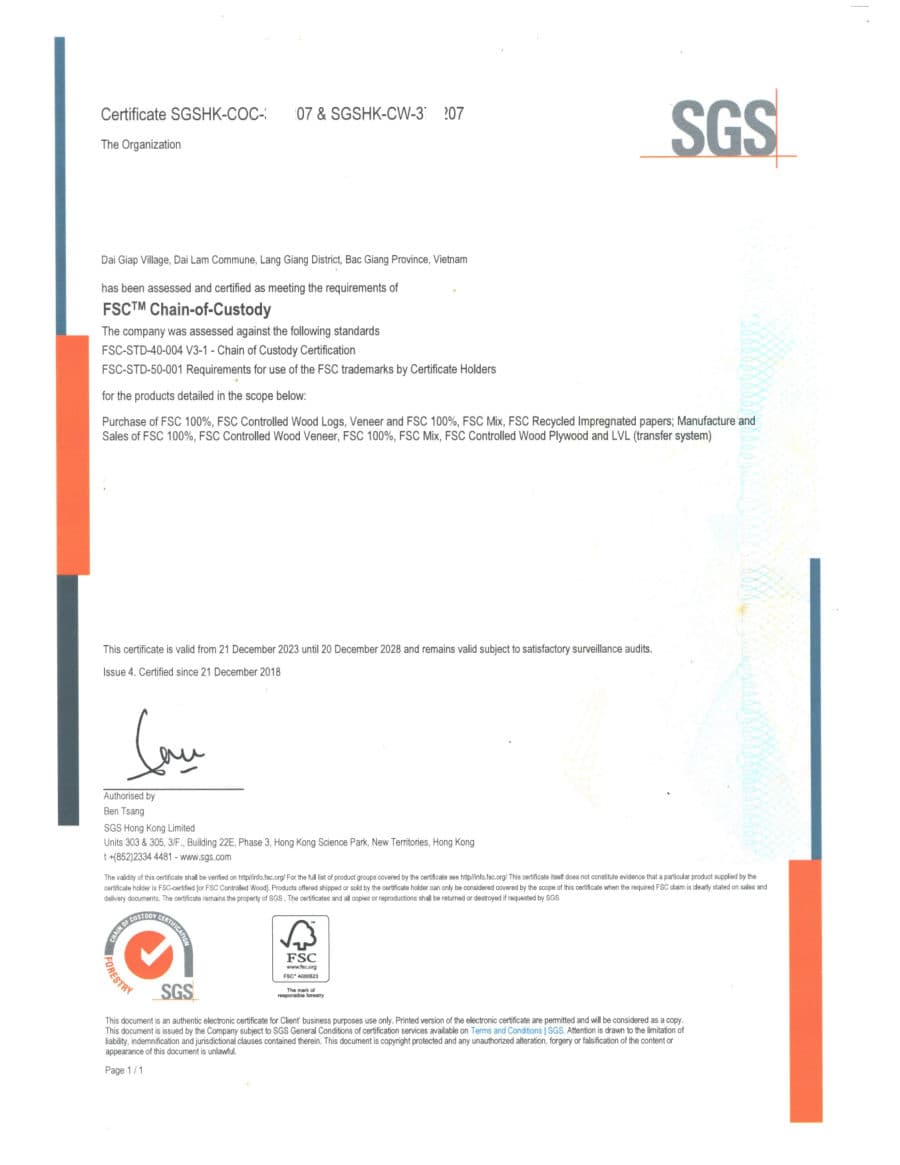
No, and this is the most expensive misunderstanding in the trade right now. FSC Chain of Custody proves a controlled flow of certified material through a supply chain. It does not by itself provide plot geolocation, and EUDR requires geolocation. A supplier with FSC has a large head start on traceability infrastructure — but the head start is not the finish line.
Questions buyers ask about this
Who is legally liable if the data turns out to be wrong?+
The EU operator who filed the Due Diligence Statement. That is you, or your customer if you sell on. This is why contractual warranties from the supplier matter: they do not remove your regulatory liability, but they give you recourse. Put the data obligations into the purchase contract, not into an email thread.
Is Vietnam a low-risk or standard-risk country?+
Check the EU country benchmarking list in force on the date you file — it is updated and we will not restate a classification here that may be out of date when you read this. Practically, plan for standard risk and full due diligence; if the classification is more favourable on the day, you have done more work than required rather than less.
How far upstream does traceability have to go for a plywood panel?+
To the plot for every wood input, including core, cross-bands and faces. A single sheet can combine material from different countries, and each wood component needs plot-level origin data. This is why multi-layer panels are harder than sawn timber, and why a supplier who only documents the face veneer has documented the smallest part of the panel.
What does a workable data pack cost me in lead time?+
Nothing, if the mill collects the data continuously as material arrives. Weeks, if they assemble it per shipment on request. That difference is the single best indicator of whether a supplier will still be able to serve you in 2027, and it is worth asking about before price.
Ask us for a past shipment's document pack
Get startedRead next
LELOI EXIM GLOBAL CO., LTD · Tax ID 2802935153