Short answer
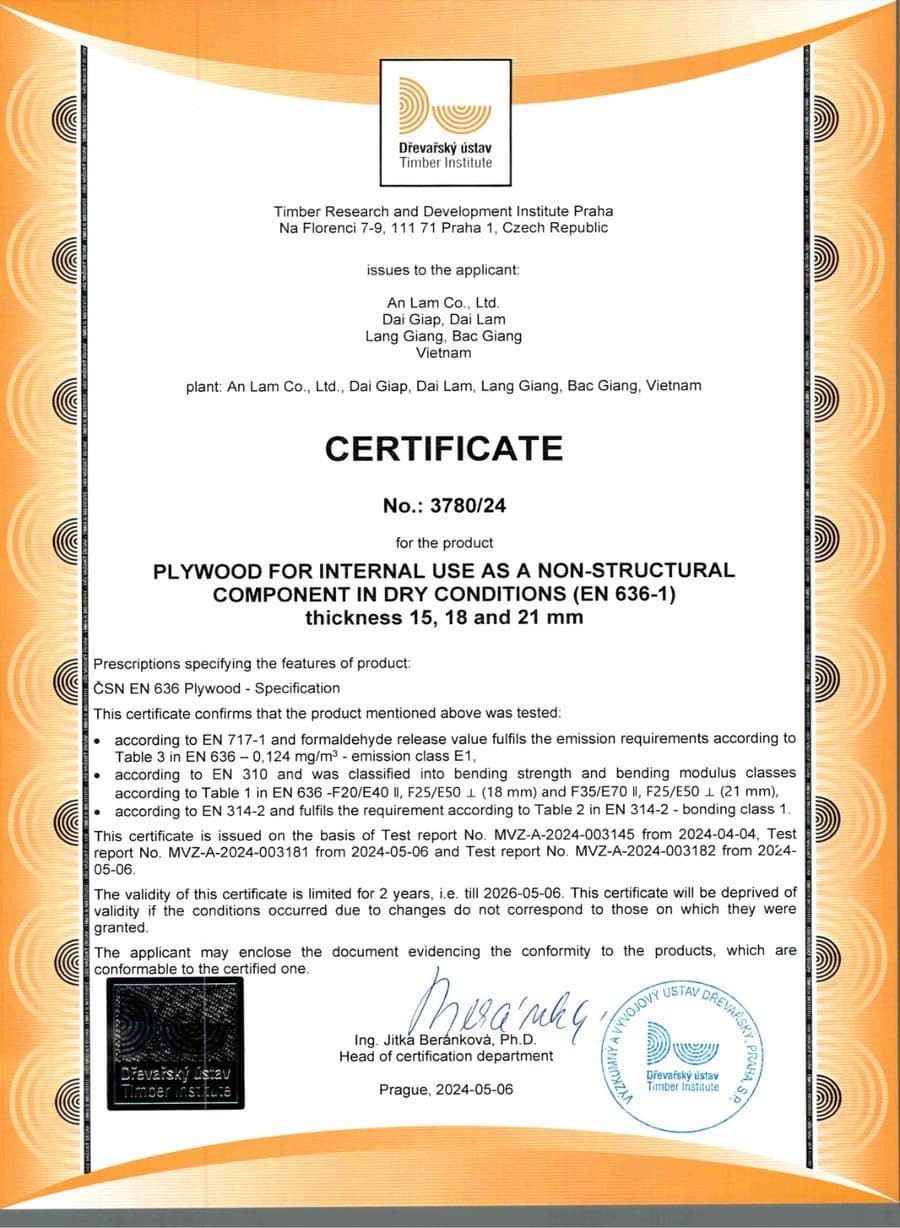
EN 13986 is the harmonised standard for wood-based panels used in construction. Where a panel is placed on the EU market for a structural or construction purpose, it needs a Declaration of Performance and CE marking covering the characteristics relevant to that use: bending strength and stiffness, bonding class, formaldehyde release, reaction to fire and, where relevant, biological durability. Panels for furniture, packaging or interior joinery outside the construction scope do not require CE marking. Ask your supplier which certificate covers which product family — our published CE certificates under EN 13986 name the mill and the product scope so you can match them to your order.
Which characteristics have to be declared?
The declared set depends on the intended use, and the Declaration of Performance must state values or 'NPD' (no performance determined) for each. For formwork and structural panels the meaningful entries are mechanical: bending strength and modulus of elasticity, bonding class under EN 314-2, and reaction to fire. For interior panels the emission class dominates.
Our film-faced line tests at 66.0 N/mm² bending strength parallel to the face grain and 54.7 N/mm² perpendicular under EN 310, bonding class 3 under EN 314-2, density 0.70 g/cm³ and moisture content 9.2% (report HJ-RD-25039). Those are the numbers a Declaration of Performance is built from, and they should be available to you before you order, not after.
Who is responsible for the CE mark on imported panels?
The manufacturer draws up the Declaration of Performance and affixes the mark; the importer must verify it exists, is correct, and that the required technical documentation is available before placing the product on the market. Importers who place a product on the market under their own name or trademark take on the manufacturer's obligations — worth knowing before you private-label a panel.
Does CE marking say anything about legality or deforestation?
Nothing at all. CE covers product performance for construction use. EUDR covers deforestation and legality. They share no evidence and satisfy no part of each other. A CE-marked panel from an undocumented supply chain is a compliant construction product that you cannot legally place on the EU market after your EUDR date.
Questions buyers ask about this
Do I need CE marking for furniture-grade plywood?+
Not for furniture manufacture as such. The trigger is intended use in construction works — structural sheathing, formwork, flooring, roofing, wall panels. If the same panel is sold for both purposes, the construction use governs. When in doubt, ask your customer what they will build with it.
Can a Vietnamese mill hold a CE certificate directly?+
Yes, through an EU notified body performing the required assessment and verification of constancy of performance. Our long-term partner mills hold CE certificates under EN 13986 with validity dates published on the certificates page, so you can check the scope and the expiry against your order rather than accepting a scan.
See published certificates and test data
Get startedRead next
LELOI EXIM GLOBAL CO., LTD · Tax ID 2802935153